A blog formerly known as Bookishness / By Charles Matthews

"Dazzled by so many and such marvelous inventions, the people of Macondo ... became indignant over the living images that the prosperous merchant Bruno Crespi projected in the theater with the lion-head ticket windows, for a character who had died and was buried in one film and for whose misfortune tears had been shed would reappear alive and transformed into an Arab in the next one. The audience, who had paid two cents apiece to share the difficulties of the actors, would not tolerate that outlandish fraud and they broke up the seats. The mayor, at the urging of Bruno Crespi, explained in a proclamation that the cinema was a machine of illusions that did not merit the emotional outbursts of the audience. With that discouraging explanation many ... decided not to return to the movies, considering that they already had too many troubles of their own to weep over the acted-out misfortunes of imaginary beings."
--Gabriel García Márquez, One Hundred Years of Solitude

Search This Blog

Showing posts with label Hasse Ekman. Show all posts

Sunday, January 4, 2026

Girl With Hyacinths (Hasse Ekman, 1950)

Ulf Palme and Anders Ek in Girl With Hyacinths

Cast: Eva Henning, Ulf Palme, Birgit Tengroth, Anders Ek, Gösta Cederlund, Karl-Arne Holmsten, Keve Hjelm, Marianne Löfgren, Björn Berglund, Anne-Marie Brunius. Screenplay: Hasse Ekman. Cinematography: Göran Strindberg. Production design: Bibi Lindström. Film editing: Lennart Wellèn. Music: Erland von Koch. 

A young woman kills herself, leaving a letter for her neighbors across the hall that names them as her heirs, even though they were only passing acquaintances. That's the setup for Hasse Ekman's Girl With Hyacinths. The neighbors, writer Anders Wikner (Ulf Palme) and his wife, Britt (Birgit Tengroth), are left to solve the mystery of why Dagmar Brink (Eva Henning) chose to take her life. Ingmar Bergman named Girl With Hyacinths as one of the greatest Swedish films, and while it never achieves the distinction of the best of Bergman's own films, it's an absorbing precursor to them. The secrets of Dagmar Brink's life are uncovered by the Wikners in a series of flashbacks, as they encounter a bristly banker (Gösta Cederlund), an alcoholic painter (Anders Ek), a giddy actress (Marianne Löfgren), Dagmar's ex-husband (Keve Hjelm), and a womanizing popular singer (Karl-Arne Holmsten). Although Anders Wikner does most of the sleuthing, it's his clever and more sympathetic wife who really understands what led to Dagmar's death, bringing to mind the collaboration of Nick and Nora Charles in The Thin Man (W.S. Van Dyke, 1934). The film also touches on themes that were taboo in the Hollywood of 1950. Hasse Ekman's skillful direction is aided by Göran Strindberg's cinematography. 

Sunday, June 30, 2024

Thirst (Ingmar Bergman, 1949)


Cast: Eva Henning, Birger Malmsten, Birgit Tengroth, Hasse Ekman, Bengt Eklund, Gaby Stenberg, Naima Wilfstrand. Screenplay: Herbert Grevenius, based on stories by Birgit Tengroth. Cinematography: Gunnar Fischer. Production design: Nils Svenwall. Film editing: Oscar Rosander. Music: Erik Nordgren.

Sunday, March 20, 2016

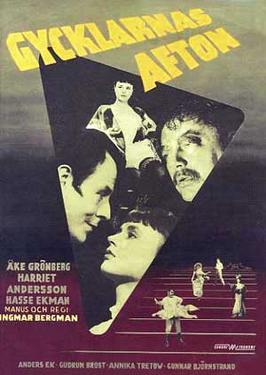
Sawdust and Tinsel (Ingmar Bergman, 1953)

When this movie was first released in the United States it was called The Naked Night, probably by exhibitors who wanted to cash in on the reputation Swedes had gained for being sexy, but especially because the film's star, Harriet Andersson, had just appeared in the nude in Summer With Monika (Ingmar Bergman, 1953), which had been passed off in some markets as a skin flick. By the time I first saw it, sometime in the 1960s, it had been renamed Sawdust and Tinsel. (The Swedish title, Gycklarnas Afton, can be translated as something like "Evening of a Clown.") Frankly, the first time I saw it, I found it tedious and heavy-handedly sordid, with its shabby, bankrupt circus and its frustrated, destructive relationships. Having grown older and perhaps somewhat wiser, I don't hate it anymore, but I can't see it as the masterpiece some do. It seems to me to lean too heavily on the familiar trope of the circus as a microcosm of the world, and on emphasizing the grunge (sawdust) and fake glamour (tinsel) of its currently prevalent title. What it has going for it is the awesome cinematography by Sven Nykvist: It was his first film for Bergman; they didn't work together again until 1960 and The Virgin Spring, but it became one of the great partnerships in filmmaking. The opening sequence of the tawdry little circus caravan trundling across the landscape is superbly filmed, and I can't help wondering if Bergman and Gunnar Fischer, the cinematographer of The Seventh Seal (1957), didn't have it in mind when they created the iconic shot of Death and his victims silhouetted against the sky in that later film. The performances, too, are excellent: Åke Grönberg as Albert, the worn-out circus owner; Andersson as his restless mistress, Anne; Hasse Ekman as Frans, the actor who rapes her; Anders Ek as the half-mad clown, Frost; and Annika Tretow as Albert's wife, who has gone on to be a success in business after he left her. But the story is heavily formula-driven: There is, for example, a rather clichéd sequence in which Albert toys with suicide, which too obviously echoes an earlier moment when Frans hammily rehearses a scene in which he kills himself while Anne watches offstage. In the end, the movie is rather like a version of Pagliacci without the benefit of Leoncavallo's music. After a disastrous performance of the circus, someone actually says, "The show's over," which is pretty much a steal from the final line of Pagliacci: "La commedia è finita!"