A blog formerly known as Bookishness / By Charles Matthews

"Dazzled by so many and such marvelous inventions, the people of Macondo ... became indignant over the living images that the prosperous merchant Bruno Crespi projected in the theater with the lion-head ticket windows, for a character who had died and was buried in one film and for whose misfortune tears had been shed would reappear alive and transformed into an Arab in the next one. The audience, who had paid two cents apiece to share the difficulties of the actors, would not tolerate that outlandish fraud and they broke up the seats. The mayor, at the urging of Bruno Crespi, explained in a proclamation that the cinema was a machine of illusions that did not merit the emotional outbursts of the audience. With that discouraging explanation many ... decided not to return to the movies, considering that they already had too many troubles of their own to weep over the acted-out misfortunes of imaginary beings."
--Gabriel García Márquez, One Hundred Years of Solitude

Search This Blog

Sunday, December 17, 2023

Clockwatchers (Jill Sprecher, 1997)

Parker Posey, Toni Collette, Lisa Kudrow, and Alanna Ubach in Clockwatchers

Cast: Toni Collette, Parker Posey, Lisa Kudrow, Alanna Ubach, Helen FitzGerald, Stanley DeSantis, Jamie Kennedy, David James Elliott, Debra Jo Rupp, Kevin Cooney, Bob Balaban, Paul Dooley. Screenplay: Jill Sprecher, Karen Sprecher. Cinematography: Jim Denault. Production design: Pamela Marcotte. Film editing: Stephen Mirrione. Music: Mader. 

Blessed are the meek, they say. Certainly Iris (Toni Collette) qualifies as meek when, on her first day as a temp at a credit company, she does as she's told and sits patiently for a very long time until Barbara (Debra Jo Rupp), the human resources manager, sees her and scolds her for not letting anyone know she was there. Self-effacing to a fault, Iris soon finds herself with a group of new friends, all temps who have been "temporary" for quite a while (a dodge companies use to keep from paying benefits). Each of them is more outgoing than Iris: Margaret (Parker Posey) is sassy and subversive, eager to point out to Iris ways to do as little work as possible. Paula (Lisa Kudrow) claims to be just passing time while waiting for her big break as an actress. Jane (Alanna Ubach) is engaged and can't wait until marriage frees her from office work. Iris's father (Paul Dooley), meanwhile, is urging her to get a good job in sales, something that her shyness makes her unsuitable for. This is the setup for Jill Sprecher's satire on contemporary work in the kind of office, scored to the artificial peppiness of Muzak, that anyone who ever worked for a corporation that values productivity over creativity, routine over initiative, and regimentation over individuality will recognize. In Clockwatchers, meekness wins out: Iris lasts longer in the job than her friends, even after the company makes their work lives more miserable than ever. But she's bested by an employee even meeker than she is, but who adds sneakiness to the meekness. As satire, I happen to think the film is a little too low key, and that the casting of vivid actresses like Posey and Kudrow, wonderful as they are, works against the mood of the film, but it has the ring of truth throughout.  

Saturday, December 16, 2023

Tales From the Crypt: Demon Knight (Ernest R. Dickerson, 1995)

Billy Zane in Tales From the Crypt: Demon Knight

Cast: Billy Zane, William Sadler, Jada Pinkett Smith, Thomas Haden Church, C.C.H. Pounder, Brenda Bakke, Dick Miller, Gary Farmer, John Kassir (voice). Screenplay: Ethan Reiff, Cyrus Voris, Mark Bishop. Cinematography: Rick Bota. Production design: Christiaan Wagener, Gregory S. Melton. Film editing: Stephen Lovejoy. Music: Edward Shearmur. 

I was going to say that failure to access the 10-year-old boy in me kept me from enjoying Tales From the Crypt: Demon Knight, but then I remembered that when I was 10 years old I thought the Tales From the Crypt comic books were repulsive trash. So maybe I really enjoyed it more than that 10-year-old would have, which isn't saying much. It's still trash, but I've seen many movies that repulsed me more. There's a tongue-in-cheek element in its slimy rotting horrors (if there's a tongue to put in a cheek or a cheek to put one in) that doesn't exactly redeem it, but at least kept me watching. And it suggests that we have come to a point in the post-Christian era that what would once be regarded as blasphemous is now only a plot device: namely, the use of the blood of Jesus as a horror movie gimmick. Mostly, it made me feel a little sorry for the actors who have to go through their paces, trying to act but knowing that anything they do is going to be chopped up in the editing and stirred into a mess of special effects. Billy Zane as the demonic Collector and William Sadler as his heroic antagonist are the nominal leads, but Jada Pinkett Smith comes off best as the ex-con on work release who labors in the boarding house where most of the action takes place. She manages to create a character we can root for, which is all the otherwise well-worn plot needs. The frame story in which the Crypt Keeper (voiced by John Kassir) introduces things is unnecessary and mainly serves to promote the HBO series from which it's a theatrical spinoff. 

Friday, December 15, 2023

For Me and My Gal (Busby Berkeley, 1942)

Gene Kelly and Judy Garland in For Me and My Gal

Cast: Judy Garland, Gene Kelly, George Murphy, Martha Eggert, Ben Blue, Stephen McNally. Screenplay: Howard Emmett Rogers, Richard Sherman, Fred F. Finkelhoffe, Sid Silvers. Cinematography: William H. Daniels. Art direction: Cedric Gibbons. Film editing: Ben Lewis. Music: Roger Edens.

Gene Kelly became a star on Broadway by playing a heel in Pal Joey, so it's fitting that he made his movie debut playing a heel who becomes a hero in For Me and My Gal. Initially, he was too much of a heel for preview audiences, who indicated that they wanted Judy Garland to wind up with George Murphy instead of Kelly. So some additional filming and editing (eliminating a lot of Murphy's role, even though he was billed second below Garland and above Kelly) made Kelly's Harry Palmer more likable. The movie doesn't free up Kelly to do the kind of show-off dancing that he would later become famous for. It's a story about vaudeville, and the songs were nostalgic oldies even when the movie was first released. Harry Palmer is an ambitious hoofer and comedian who will stop at nothing to get to the top: the Palace in Manhattan. He muscles into the spotlight, breaking up with partners and stealing musical arrangements, to wind up teaming with Jo Hayden (Garland), whose ambition is similar to his but restrained by a conscience. When World War I starts, Harry breaks his hand to keep from getting drafted just as they're about to play the Palace and she tells him off, leaving the act. Naturally, the plot hinges on Harry's redemption. Busby Berkeley's direction keeps things lively, though the film doesn't feature the kaleidoscopic production numbers he became famous for at Warner Bros. and in three of MGM's "hey, kids, let's put on a show" musicals with Garland and Mickey Rooney. There's a subplot involving Harry's flirtation with a star called Eve Minard, played by Martha Eggerth, a Hungarian soprano famous for her performance in operettas. She was signed by MGM possibly as a replacement for Jeanette MacDonald, whose career as the studio's house soprano was ending. Eggerth sings splendidly, but she photographed less well, and the house soprano job went to Kathryn Grayson. For Me and My Gal is full of historical interest -- it was also the first movie for which Garland received top billing -- but it feels a little canned and unoriginal in comparison to the Freed Unit classics that followed.  

Thursday, December 14, 2023

The Addiction (Abel Ferrara, 1995)

Lili Taylor in The Addiction

Cast: Lili Taylor, Christopher Walken, Annabella Sciorra, Edie Falco, Paul Calderon, Fredro Starr, Kathryn Erbe, Michael Imperioli, Robert W. Castle. Screenplay: Nicholas St. John. Cinematography: Ken Kelsch. Production design: Charles M. Lagola. Film editing: Mayin Lo. Music: Joe Delia. 

Blood looks bloodier in black-and-white. In color it too often looks like ketchup or cranberry juice or corn syrup with red food dye. But under the lens and lights of cinematographer Ken Kelsch in The Addiction it turns black, flat and dry like an aging wound or glossy like the spill of an unsavory substance. And there's a lot of it in the film, which turns vampirism into a metaphor for not only drug addiction but any other self-destructive obsession. When Kathleen Conklin (the terrific Lili Taylor) is turned vampire, her attacker (Annabella Sciorra) tells her to resist, and after Kathleen is addicted, she makes a similar offer to her own victims: They should tell her to go away. Except "victims" is maybe the wrong word here. The film is about something as banal as responsibility or yielding to temptation: It almost devolves into a "just say no" moral treatise, except that it also exposes the inanity of that maxim. Christopher Walken plays a vampire who has managed to get his bloodlust under control, except that we can see the price he has paid doing so. As Macbeth put it, "I am in blood / Stepped in so far, that, should I wade no more, / Returning were as tedious as go o'er." Admonitions against self-destructive behavior aside, The Addiction is a fable with rich intellectual content, a meditation on human appetite and attempts to control it. That it's also a pretty damn good horror movie is only part of it. 


Wednesday, December 13, 2023

The Lady and the Beard (Yasujiro Ozu, 1931)

Tokihiko Okada in The Lady and the Beard
Cast: Tokihiko Okada. Hiroko Kawasaki, Satoko Date, Choko Iida, Ichiro Tsukida, Toshiko Iizuka, Mitsuko Yoshikawa, Tatsuo Saito, Takeshi Sakamoto, Sotaro Okada, Yasuo Nanjo, Ayako Katsuragi. Screenplay: Komatsu Kitamur, Yasujiro Ozu. Cinematography: Minoru Kuribayashi, Hideo Shigehara. Film editing: Minoru Kuribayaski, Hideo Shigehara. 

The Lady and the Beard is one of Yasujiro Ozu's silent comedies that, like I Graduated, But... (1929), I Flunked, But ... (1930), and Where Now Are the Dreams of Youth? (1932), center on college students and their postgraduate life. The protagonist, Kiichi (Tokhiko Okada), affects a full beard and old-fashioned dress, which his fellow students tolerate laughingly, but which opens him to mockery when he goes home with a friend who invites him to his sister's birthday party. The young women at the party shun him. Worse, when he graduates, he discovers that the beard is an obstacle to getting a job. So he shaves it off, and suddenly finds that he's not only employable but also a magnet to marriageable young women. He rescues Hiroko (Hiroko Kawasaki) from being mugged by Furyo (Satoko Date) and her thuggish companions, and winds up attracting the attention of both women. Later, he encounters Furyo again at the hotel where he works: He thwarts her in a con job involving a piece of jewelry, but that doesn't deter her interest in him. It's a likable little comedy with an endearing performance by Okada. I occasionally had trouble following some of the narrative, whether because of cultural differences or missing footage -- the print shows signs of damage. As often with Ozu's early films, he shows his inspiration in the form of movie posters on the characters' walls: Kiichi's room has a poster of a Laurel and Hardy movie. Ozu credits himself, under his pseudonym James Maki, as the film's gag writer. 

Tuesday, December 12, 2023

In the Mouth of Madness (John Carpenter, 1994)

Julie Carmen and Sam Neill in In the Mouth of Madness
Cast: Sam Neill, Julie Carmen, Jürgen Prochnow, David Warner, John Glover, Bernie Casey, Peter Jason, Charlton Heston, Frances Bay. Screenplay: Michael De Luca. Cinematography: Gary B. Kibbe. Production design: Jeff Ginn. Film editing: Edward Warschilka. Music: John Carpenter, Jim Lang.

A box office failure in its theatrical debut, John Carpenter's cleverly recursive In the Mouth of Madness has since gathered an enthusiastic following. I'm not one of the enthusiasts -- I find it much too frantic to be very scary, entertaining, or thought-provoking -- but I see what they like about it. It's partly a satiric look at the popularity of horror fiction and its movie spinoffs, centering on an obvious target: Stephen King. In the film, the horror writer is called Sutter Cane (Jürgen Prochnow), who lives in New Hampshire (next door to Maine, where King lives). Maybe to avoid any legal problems, the analogy is made explicit in the movie: King is name-checked several times. The other obvious horror writer target is H.P. Lovecraft, who isn't mentioned, but he's dead and can't sue. One reason for my discontent with In the Mouth of Madness is the miscasting of Sam Neill, who plays an insurance investigator who gets caught up in the search for Sutter Cane and his latest manuscript. Neill is one of my favorite underappreciated actors, but he seems all at sea here: Even his well-practiced American accent is sometimes clotted with his native New Zealand vowels. The role, which has a comic undertone, needs a more smart-alecky performer like Jim Carrey or Bill Murray. But then most of the cast -- including a cameo by Charlton Heston and a screen debut by Hayden Christensen as a paperboy -- is just along for the ride as the special effects and the plot kinks mount up. 


Monday, December 11, 2023

Mandabi (Ousmane Sembene, 1968)

Ynousse N'Diaye, Makhouredia Gueye, and Isseu Niang

Cast: Makhouredia Gueye, Ynousse N'Diave, Isseu Niang, Mustapha Ture, Farba Sarr, Serigne Diayes, Thérèse Bas, Mouss Diaf, Christof Colomb. Screenplay: Ousmane Sembene. Cinematography: Paul Soulignac. Film editing: Gilbert Kikoïne, Max Saldinger.

When we first see Ibrahim Dieng (Makhouredia Gueye), he is having his head shaved and his nose cleaned. Then he strolls through the streets of Dakar, immaculate head held high, the very image of smug prosperity. He is anything but prosperous, of course: He is stone broke, having been unemployed for a very long time, supporting himself, his two wives, and seven children with a combination of handouts and loans, sustained mainly by his pride and a Micawberish sense that something will turn up. That something turns up in the form of a money order from his nephew, a street sweeper in Paris, and it will be the undoing of Ibrahim. Most of the money his nephew sent is not his: Part of it is to go into the nephew's savings, part to his mother, Ibrahim's sister (Thérèse Bas), who is a formidable force herself. The little left over goes to Ibrahim, and the thought of it elicits a brief period of delight -- one of the wives even makes up a song about the money order. But when word of it gets about, Ibrahim is immediately set upon by creditors and handout seekers. Mandabi (which means "money order") is a tragicomic film about postcolonial Africa, its people strangled by governmental corruption. Ibrahim is caught in a Catch-22: He can't cash the money order without an identity card. He can't get an identity card without a birth certificate. He can't get a birth certificate without some form of identification. The bureaucracy that frustrates him is both Dickensian and Kafkaesque. Ousmane Sembene tells Ibrahim's story with sympathy, but also with a smart distancing from the character, whose faults he makes all too clear. The only problem I had with the film is that it ends with a didactic speech by a character delivering the message: People should work to end the corruption that results in such misery. But Mandabi wasn't made for me, but for people like the ones it portrays. It was the first feature made in Wolof, the indigenous language of Senegal, which Sembene chose over French, the official language imposed by colonialism. "Message movies" may be tiresome to us Westerners, but they were an important tool for filmmakers like Sembene. 

Sunday, December 10, 2023

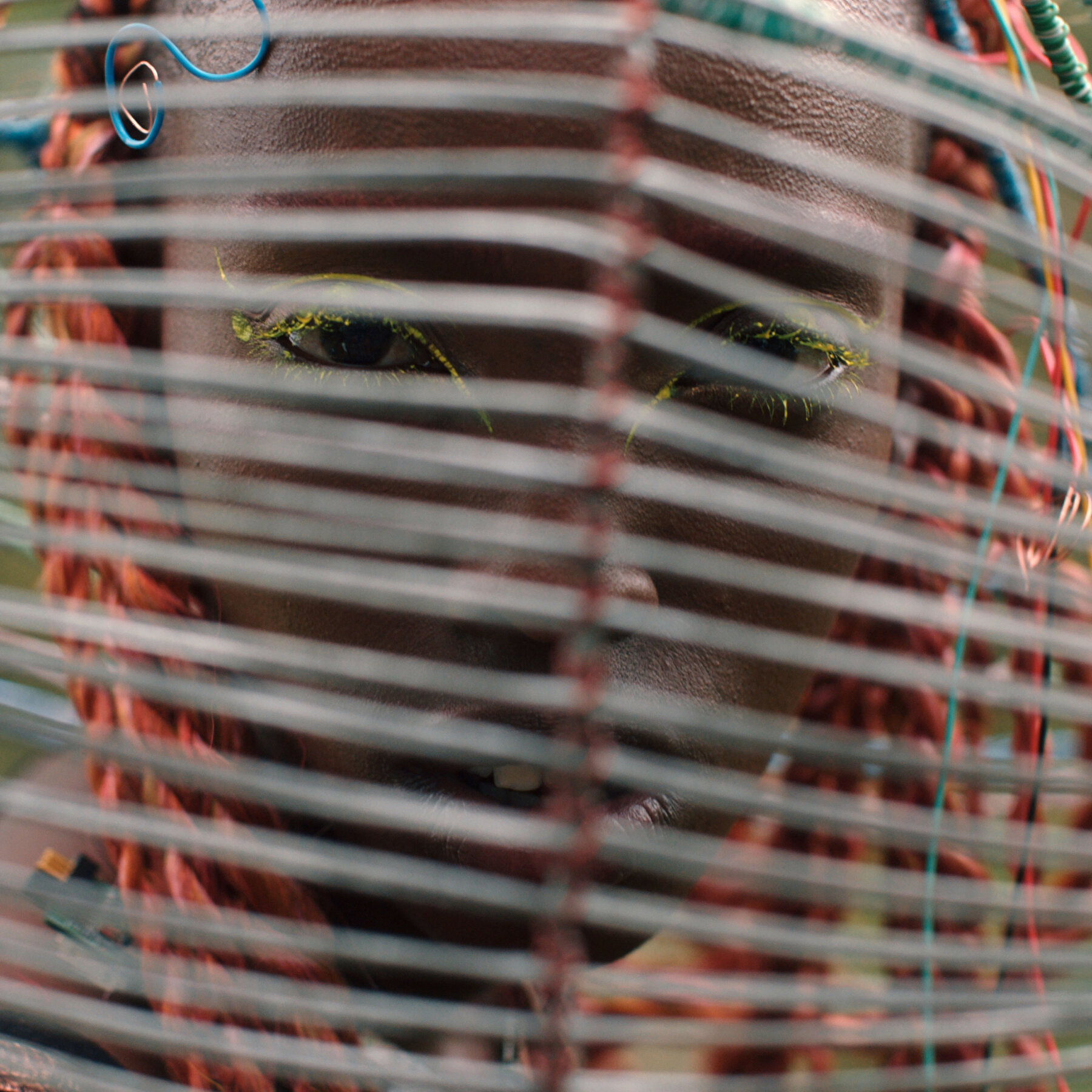
Neptune Frost (Anisia Uzeyman, Saul Williams, 2021)


Cast: Cheryl Isheija, Elvis Ngabo, Bertrand Ninteretse, Elane Umuhire, Dorcy Rugamba, Rebecca Uwamahoro, Trésor Niyongabo, Eric Ngangare, Natacha Muziramakenga, Cécile Kayirebwa, Diogène Ntarindwa. Screenplay: Saul Williams. Cinematography: Anisia Uzeyman. Production design: Cedric Mizero, Antoine Nshimiyimana. Film editing: Anisha Achyara. Music: Saul Williams. Costume design: Cedric Mizero.

Neptune Frost is ... well, what is it? An American-Rwandan anti-colonialist, anti-capitalist queer sci-fi musical about the confluence of the autochthonic and technology? If you go looking for more descriptives, you'll encounter concepts like "cyberpunk" and "Afrofuturist" that seem appropriate but also insufficient to characterize the film. And don't expect any spoilers here; I couldn't go into particulars on the plot if you forced me to. It starts in a coltan mine: That's the ore from which the stuff that helps run our computers and cell phones and whatnot is refined. It's a "conflict mineral": Wars, trade and otherwise, are fought over it. And then the story moves, through the peregrinations of our protagonists, Neptune, played by both Cheryl Isheija and Elvis Ngabo (the character is intersex), and Matalusa (Bertrand Ninteretse, aka Kaya Free), to an e-waste dump that becomes a hacker community that takes over the world's computers. Confused? Just go with it: This is an extraordinary movie, both in the watching and in the backstory of how it was made. There is poetry and wit here that needs more than one viewing to assimilate. For example, the name Matalusa is a Joycean pun: "martyr and loser," and by the end of the film it becomes Matalusa King -- Martin Luther King. It's full of music and color -- a special nod to Cedric Mizero's costume design. Maybe it's not a film for everyone, but I am dazzled and baffled by it.     

Saturday, December 9, 2023

Party Girl (Daisy von Scherler Mayer, 1995)

Parker Posey in Party Girl

Cast: Parker Posey, Anthony DeSando, Guillermo Díaz, Donna Mitchell, Liev Schreiber, Omar Townsend, Sasha von Scherler, Becky Mode, Simon Verhoeven. Screenplay: Harry Birckmayer, Daisy von Scherler Mayer, Sheila Gaffney. Cinematography: Michael Slovis. Production design: Kevin Thompson. Film editing: Cara Silverman. Music: Anton Sanko. 

With its larky portrayal of the Manhattan club scene of the 1990s, Party Girl reminded me of those "swinging London" movies of the 1960s, like Richard Lester's The Knack ... and How to Get It (1965). You might even think of Parker Posey as the Rita Tushingham of the '90s. But The Knack now feels tired and dated, while Party Girl remains fresh. Or maybe I feel a special affection for Party Girl because I spent my youth mastering the Dewey Decimal System instead of partying, and it's nice to see a movie that validates my lifestyle, even ironically. Party Girl also is ethnically and sexually more diverse than those '60s movies were, or could have been. The odd thing is that a lot of critics of the time didn't get it. A British reviewer bosleycrowthered, "If bad behaviour and smugness were truly charming, Party Girl might be as much fun as it thinks it is." And even Roger Ebert dismissed it, saying that Posey's character's "life is disorganized, ... but the script could nevertheless organize its approach to her, so the audience wouldn't feel as confused as she is most of the time.... But the movie never pulls itself together." Which I think misses the point: Why ask for an eight-course meal when what you really want is a falafel with hot sauce, a side order of baba ganoush, and a seltzer? 

Friday, December 8, 2023

When a Stranger Calls Back (Fred Walton, 1993)


Cast: Carol Kane, Charles Durning, Jill Schoelen, Gene Lythgow, Kevin McNulty, Cheryl Wilson, Jerry Wasserman. Screenplay: Fred Walton. Cinematography: David Geddes. Production design: Chris August. Film editing: David Byron Lloyd. Music: Dana Kaproff. 

I haven't seen When a Stranger Calls, Fred Walton's 1979 film, but I gather that it helped launch the horror movie trope "the phone call's coming from inside the house!" There are no calls coming from inside or outside the house in Walton's sequel, When a Stranger Calls Back, because the phone line has been cut. (The film was obviously made before the ubiquity of cell phones.) The setup is a standard one for horror movies: A babysitter is terrorized by a mysterious stranger. In this case, Julia (Jill Schoelen) is a high school student called in at the last moment to sit for a couple's two small children, who have already gone to bed by the time she arrives. As she settles in, there's a knock on the door, which she cautiously answers from inside, not unlocking or opening the door. The voice outside explains that his car has broken down and he'd like to use the phone to call for help. She volunteers to make the call herself, and after some back and forth, he reluctantly agrees, giving her the information she needs. But when she goes to the phone, the line is dead. Still wary, she lies to the man outside, claiming that she made the call, but hoping he'll go elsewhere for help. Walton handles this part of the film efficiently and effectively as things gradually escalate until Julia realizes that the man is inside the house. Fortunately, the parents arrive just in time to save her, but they discover that the children are missing from their upstairs bedroom. Then the film falls apart. Five years pass, and Julia is now a college student. Still suffering the effects of the earlier incident, she begins noticing strange things happening in her apartment. The police are dismissive, but they call on a counselor from the college to help. She turns out to be Jill Johnson (Carol Kane), who was the victim in original film. Jill has good reason to trust Julia's instincts and calls in John Clifford (Charles Durning), the detective from her case. But the convergence of the separate experiences of Jill and Julia muddles the narrative, as both women become terrorized by the new bad guy. And then the movie comes to a thuddingly ridiculous end, as Clifford figures out that the guy must be a ventriloquist. As any 10-year-old kid who has ever tried it knows, ventriloquists rely on visual misdirection: moving the dummy's mouth while keeping theirs nearly motionless. They can't really "throw" their voices, as the movie suggests the guy outside Julia's door did. When a Stranger Calls Back was made for television and first appeared on Showtime, then was released on video. Despite some creepy moments, I suspect that it would have been laughed out of theaters.