A blog formerly known as Bookishness / By Charles Matthews

"Dazzled by so many and such marvelous inventions, the people of Macondo ... became indignant over the living images that the prosperous merchant Bruno Crespi projected in the theater with the lion-head ticket windows, for a character who had died and was buried in one film and for whose misfortune tears had been shed would reappear alive and transformed into an Arab in the next one. The audience, who had paid two cents apiece to share the difficulties of the actors, would not tolerate that outlandish fraud and they broke up the seats. The mayor, at the urging of Bruno Crespi, explained in a proclamation that the cinema was a machine of illusions that did not merit the emotional outbursts of the audience. With that discouraging explanation many ... decided not to return to the movies, considering that they already had too many troubles of their own to weep over the acted-out misfortunes of imaginary beings."
--Gabriel García Márquez, One Hundred Years of Solitude

Search This Blog

Showing posts with label Marguerite Duras. Show all posts

Sunday, September 20, 2026

Baxter, Vera Baxter (Marguerite Duras, 1977)

Claudine Gabay and Delphine Seyrig in Baxter, Vera Baxter

Cast : Delphine Seyrig, Claudine Gabay, Gérard Depardieu, Noëlle Châtelet, Claude Aufaure, François Périer ( voice ). Screenplay : Marguerite Duras. Cinematography: Sacha Vierny. Film editing : Dominique Auvray, Caroline Camus, Roselyne Petit. Music : Carlos D'Alessio. 

Static in the extreme, Marguerite Duras's Baxter, Vera Baxter gets what little energy it has from the music of Carlos D'Alessio, a kind of nagging on-again, off-again presence throughout the film that is explained as coming from a nearby party, although Duras clearly doesn't intend us to take the explanation seriously. Otherwise, it's a movie about people talking about the title character (Claudine Gabay) and her husband, Jean (François Périer's voice), and a man named Michel Cayre (Gérard Depardieu in what amounts to a cameo). Most of this talk is generated by a woman who remains anonymous (Delphine Seyrig), who hears the name Vera Baxter in a hotel bar and decides to know more. It takes her about 90 minutes to explore the marriage of Vera and Jean and its relationship to Michel, and if you're like me, you may be wondering why we should care. This is cinema as contemplative object, which goes against the very nature of the medium. 

Friday, January 15, 2016

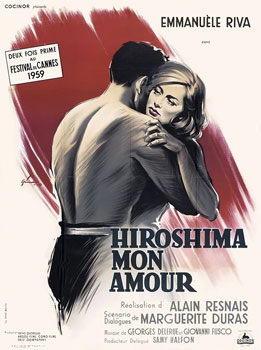
Hiroshima Mon Amour (Alain Resnais, 1959)

I remember the long dorm-room discussion after my friends and I saw this film for the first time, so I was surprised on returning to it after so many years how conventional the elements we talked about now seem. The extended use of documentary clips at the beginning of the film, with the voiceover by the lovers (Emmanuelle Riva and Eiji Okada) arguing about whether she had really seen anything in Hiroshima, seemed to us a bafflingly random way to start a movie. The jump cuts into and out of flashbacks confused us. What, we argued, did it signify that their entwined bodies, seemingly covered with ashes, then began to glow? (Today, I'm afraid some sarcastic voice will pipe up to say, "They've been glitter-bombed.") Why does she refer to her Japanese lover as "you" when she's actually talking about the German she loved during the war? Is the movie really about sleeping with the enemy? Doesn't it trivialize the horror of Hiroshima to bring it down to the level of the background for a love affair? Today, we'd regard those questions as naive, and I'm certain we wouldn't be confused by the film's structure, which is a way of saying that Resnais and his screenwriter, Marguerite Duras, really did succeed in revolutionizing movies. But if no one is startled by jump cuts or unconventional narrative devices today, there remains a raw immediacy about the film that no subsequent imitators have ever quite succeeded in equaling. Much credit also has to go to the score by Georges Delerue and Giovanni Fusco, and to the editing by Michio Takahashi and Sacha Vierny.