A blog formerly known as Bookishness / By Charles Matthews

"Dazzled by so many and such marvelous inventions, the people of Macondo ... became indignant over the living images that the prosperous merchant Bruno Crespi projected in the theater with the lion-head ticket windows, for a character who had died and was buried in one film and for whose misfortune tears had been shed would reappear alive and transformed into an Arab in the next one. The audience, who had paid two cents apiece to share the difficulties of the actors, would not tolerate that outlandish fraud and they broke up the seats. The mayor, at the urging of Bruno Crespi, explained in a proclamation that the cinema was a machine of illusions that did not merit the emotional outbursts of the audience. With that discouraging explanation many ... decided not to return to the movies, considering that they already had too many troubles of their own to weep over the acted-out misfortunes of imaginary beings."
--Gabriel García Márquez, One Hundred Years of Solitude

Search This Blog

Sunday, January 7, 2024

Little Odessa (James Gray, 1994)

Tim Roth and Edward Furlong in Little Odessa

Cast: Tim Roth, Edward Furlong, Moira Kelly, Vanessa Redgrave, Maximilian Schell, Paul Guilfoyle, Natalya Andrejchenko, David Vadim. Screenplay: James Gray. Cinematography: Tom Richmond. Production design: Kevin Thompson. Film editing: Dorian Harris. 

James Gray's debut film, Little Odessa, is a chilly movie about a dysfunctional family, set in wintry Brighton Beach, the Brooklyn neighborhood adjacent to Coney Island. Gray uses the seasonally shut down amusement park and boardwalk as a correlative for the frozen lives of the Shapira family, for which a reviving spring will never arrive. The film won more favor from European critics, winning an award at the Venice Film Festival and praise from director Claude Chabrol, than it did from Americans, who have less taste for grimness. And Little Odessa is almost unrelievedly grim in its account of what happens when the older son, Joshua, returns to the home where his mother, Irina (Vanessa Redgrave), is dying of cancer. He hates his father, Arkady (Maximilian Schell), who is having an affair with a younger woman while tending to Irina in her final days. Joshua feels close, however, to his teenage brother, Reuben (Edward Furlong), who dutifully helps his father run a small newsstand and look after his mother, but he has secretly stopped going to school, hiding the letters to his parents from the school in his sock drawer. Joshua is a hitman for the Russian mob. He has avoided returning home, but he can't refuse an order to rub out an Iranian jeweler with a store located in Brighton Beach. There are violent consequences not only for Joshua's target but also for his own family. The Shapira family is not so poetic and articulate as the Tyrones of Long Day's Journey Into Night (Sidney Lumet, 1962) but they have a similar lacerating candor that gives actors free rein to perform. And it's mostly the performances that justify spending 98 minutes with them (as compared to the nearly three hours we spend with the Tyrones in Lumet's film). Redgrave, as always, is a marvel, all fragility and grit and love for her family, and Furlong demonstrates the kind of promise as an actor that his personal problems have never allowed him to fulfill. I think Schell is somewhat miscast as the father, who gets the blame for what has happened to his sons, but he gives the role substance if not the undertones of selfishness and desperation that it needs. The real star is Roth, an undervalued actor who always performs to the mark and beyond. Gray's screenplay is a touch too melodramatic, especially in the final confrontation of Joshua and his father, but with the help of Tom Richmond's cinematography and Kevin Thompson's production design, he maintains the oppressive mood and gloomy milieu effectively.  


Saturday, January 6, 2024

Guelwaar (Ousmane Sembene, 1992)

Thierno Ndiaye and Mame Ndoumbé Diop in Guelwaar

Cast: Thierno Ndiaye, Mame Ndoumbe Diop, Omar Seck, Ndiawar Diop, Marie Augustine Diatta, Moustapha Diop, Babacar Faye, Sadara Mbaye. Screenplay: Ousmane Sembene. Cinematography: Dominique Gentil. Film editing: Marie-Aimée Debril. Music: Baaba Mal. 

The protagonist of Ousmane Sembene's sharply ironic tragicomedy Guelwaar is postcolonial Africa itself, viewed with a mixture of hope and frustration like that of the Europeanized Barthelemy (Nidiawar Diop) in the film, who often utters an exasperated "Africa!" when he encounters bureaucratic and cultural roadblocks in his attempt to bury his father. Actually, Barthelemy is trying to re-bury his father, Pierre Henri Thioune (Thierno Ndiaye), a political activist called by his followers "Guelwaar" (noble one), who died following a beating by political opponents. His body was mistakenly removed from the morgue and buried in a Muslim cemetery. Although Pierre Henri was a Catholic, the heads of the Muslim community don't want the grave disturbed to verify the identity of the corpse. The expatriate Barthelemy is not the best person to handle the problem, attracting suspicion from the authorities because he has become a French citizen, but he's the only member of the family capable of taking charge: His widowed mother, Nogoy Marie (Mame Ndoumbé Diop), is prostrate with grief; his sister, Sophie (Marie Augustine Diatta), is a sex worker in Dakar, and hence something of an outcast; and his younger brother, Alois (Moustapha Diop), is handicapped, crippled after a fall from a tree. Tensions build between Catholics and Muslims, and ultimately troops are called in by the area's representative in the legislature to keep violence from breaking out. Sembene tells the story beautifully, if occasionally resorting to the kind of blatant expository dialogue and didactic commentary aimed at his audience. Pierre Henri's radical politics center on an issue that reminds us how the causes of both right and left can sometimes converge: foreign aid to developing counties. He opposes the shipments of supposedly humanitarian aid such as food to his country, seeing it a tool used by foreign governments to gain influence, a cause of corruption in the government that distributes it, and a hindrance to the growth of a self-sustaining Africa. Sembene clearly endorses that view when, at the very end of the film, the young followers of the Guelwaar tear open the bags of rice and flour and the procession of carts carrying the funeral entourage drives over the spillage in an ironic triumph. With its keen portrayal of religious tensions, corruption, bureaucracy, and economic hardship, Guelwaar is a fine satiric blend of humor and pain, one of Sembene's best films.

Thursday, January 4, 2024

The Killer (David Fincher, 2023)

Michael Fassbender in The Killer

Cast: Michael Fassbender, Tilda Swinton, Charles Parnell, Arliss Howard, Kerry O'Malley, Sophie Charlotte, Emiliana Pernia, Gabriel Polanco, Sala Baker, Monique Ganderton, Daran Norris, Jack Kesy. Screenplay: Andrew Kevin Walker, based on a graphic novel series by Alexis Nolent and Luc Jacamon. Cinematography: Erik Messerschmidt. Production design: Donald Graham Burt. Film editing: Kirk Baxter. Music: Trent Reznor, Atticus Ross. 

In essence, The Killer is a routine thriller about a hit man who screws up and then has to undo the consequences of his screwup. But director David Fincher, screenwriter Andrew Kevin Walker, and actor Michael Fassbender make it seem fresh and novel, not by departing from formula but by creating characters and giving them something fresh to say. Fassbender is The Killer (most of the dramatis personae are given labels rather than names), a lean, mean killing machine who rises above that cliché by a variety of quirks, including an addiction to maxims and mottoes that we hear from constantly in voiceover: "Stick to your plan. Anticipate, don't improvise. Trust no one. Never yield to an advantage. Fight only the battle you're paid to fight." Even by itself that constant voiceover could be annoying, except that Fassbender makes it amusing by intoning it in a flat American accent, and by occasionally failing to follow his own advice. Fincher spends a long time on the setup to the first kill, which makes it even more startling when the suspense is broken by the Killer's mistake. There's some swift action as he gets rid of the equipment used in the shoot, then boards a plane (using one of his many passports and credit cards, all carrying fake names borrowed from TV characters) for his home in the Dominican Republic, where he finds that he still has to keep running, eliminating not only those pursuing him, but also everybody else who knows his true identity. These incidents introduce us to a variety of characters, wittily played by, among others, Charles Parnell (The Lawyer, aka Hodges, who is a middle man between The Killer and his targets), Tilda Swinton (The Expert, a fellow assassin who knows his identity), and Arliss Howard (The Client, one of the few people The Killer manages to intimidate but not kill). All of this nonsense -- which is praise, not criticism -- is set to a variety of songs, mostly by the Smiths, whose dark humor perfectly complements the style of the movie. I could quibble about this being one of those films in which the big fight scene takes place in the dark, so you're never quite sure who's beating whom, but then moral ambiguity is the whole point of the movie. 

The Great Sinner (Robert Siodmak, 1949)

Gregory Peck and Ava Gardner in The Great Sinner

Cast: Gregory Peck, Ava Gardner, Melvyn Douglas, Walter Huston, Ethel Barrymore, Frank Morgan, Agnes Moorehead. Screenplay: Ladislas Fodor, Christopher Isherwood, René Fülöp-Miller, based on a novella by Fyodor Dostoevsky. Cinematography: George J. Folsey. Art direction: Hans Peters, Cedric Gibbons. Film editing: Harold F Kress. Music: Bronislau Kaper. 

Gregory Peck's handsomeness and charisma made him a movie star, and served him well in films like Roman Holiday (William Wyler, 1953) and To Kill a Mockingbird (Robert Mulligan, 1962), but he never achieved the gravitas and vulnerability that would have made him a great actor. Unfortunately, both of those characteristics are what was needed to play the Dostoevskyan protagonist of The Great Sinner, loosely based on the novella The Gambler, with borrowings from Crime and Punishment and the author's own life, including his epilepsy and his addiction to gambling. The handsomely mounted production was a prestige project for MGM, but it ran into problems with the script and director Robert Siodmak's reluctance to film it as written. After the first cut, Siodmak was replaced by Mervyn LeRoy, with instructions to make more of the romance between the characters played by Peck and Ava Gardner. The cuts made in the film may explain why the roles played by Agnes Moorehead and Ethel Barrymore seem to be cast more generously than they deserve, considering the time they spend on screen. The "sin" of the title is gambling, of course, but the topic of gambling addiction is perfunctory at best. There are some good lines in the screenplay, such as the casino employee's observation that it's hard to detect patrons who are suicidal: "They smile right before they pull the trigger." And Ava Gardner is, as Peck's character calls her, "irritatingly beautiful." There's no excuse, however, for the swooningly pious climax of the film and the unconvincing happy ending. Best to skip The Great Sinner and watch a better movie about glamorous addicted gamblers, Jacques Demy's Bay of Angels (1963). 

Wednesday, January 3, 2024

The Only Son (Yasujiro Ozu, 1936)

Choko Iida and Shinichi Himori in The Only Son

Cast: Choko Iida, Shinichi Himori, Masao Hayama, Yoshiko Tsoubuchi, Mitsuko Yoshkawa, Chishu Ryu, Tomio Aoki. Screenplay: Yasujiro Ozu, Tadao Ikeda, Masao Arata. Cinematography: Shojiro Sugimoto. Production design: Tatsuo Hamada. Film editing: Eiichi Hasagawa, Hideo Mohara. Music: Senji Ito. 

If someone were to ask me what movie by Yasujiro Ozu they should watch first, I'd probably suggest the one that makes the critics' lists of the greatest films ever made, Tokyo Story (1953), or perhaps his very last one, An Autumn Afternoon (1962). I probably wouldn't select his first talkie, The Only Son, but only because the print I saw was blotchy and its soundtrack occasionally noisy. It's also one of his most melancholy films, drenched in the kind of disappointment that Ozu himself must have felt in the Depression year of 1936 as militarism took stronger hold on Japan. It tells the simple story of a single mother, O-Tsune (Choko Iida), who supports her son, Ryosuke (Shinichi Himori), by working in a silk mill as he grows up, gets an education, and moves to Tokyo determined to be a "great man." But when she pays a visit to him there, she discovers that he has married and has an infant son of his own, and that the little family is struggling to make ends meet. The best job he's able to find is teaching night school. His failure to thrive mirrors that of the teacher, Okubo (Chishu Ryu), who mentored him, urging him to further his education, and went to Tokyo himself to advance his career. Now, even the teacher is struggling, supporting his wife and four children by running a small tonkatsu restaurant. Ryosuke, who is living from paycheck to paycheck, borrows money from friends so he can show his mother a good time in Tokyo. They do some sightseeing and he takes her to the movies. The film is Unfinished Symphony (Willi Forst and Anthony Asquith, 1934) a British-Austrian biopic of Franz Schubert that Ozu uses for an ironic allusion: It's about a disappointed genius and it has dialogue in German, echoing the fact that Japan signed a pact with Hitler's Reich in 1936. Ryosuke tries to impress his mother by pointing out that it's "a talkie," but she nods off during the film -- perhaps Ozu's sly dismissal of the medium that he has finally been persuaded to adopt. Though it's touched with humor, The Only Son persists in its melancholy portrait of failed hopes, ending with Ryosuke's vow that he will go back to school and get a better job. O-Tsune returns to her work in the mill, and tells her friends that her son has become a great man, but her face when she's alone reveals the truth.    

Tuesday, January 2, 2024

The Anniversary Party (Jennifer Jason Leigh, Alan Cumming, 2001)

Alan Cumming and Jennifer Jason Leigh in The Anniversary Party

Cast: Jennifer Jason Leigh, Alan Cumming, Kevin Kline, Phoebe Cates, John C. Reilly, Jane Adams, Parker Posey, John Benjamin Hickey, Gwyneth Paltrow, Denis O'Hare, Mina Badie, Michael Panes, Jennifer Beals, Matt Malloy. Screenplay: Jennifer Jason Leigh, Alan Cumming. Cinematography: John Bailey. Production design: Emma Bailey. Film editing: Carol Littleton, Suzanne Spangler. Music: Michael Penn.  

Hollywood professionals Alan Cumming and Jennifer Jason Leigh wrote, directed, and starred in The Anniversary Party, a movie about a gathering of Hollywood professionals. Which at least follows the advice to write about what you know. But that way lies a certain insularity, which is probably the biggest problem their movie has. Watching it made me feel like an outsider, even a voyeur. They play a couple, actress Sally Nash and novelist turned filmmaker Joe Therrian, who have recently put their marriage back together after a separation, and are celebrating their sixth wedding anniversary -- not usually a landmark occasion, but considering their marital difficulties can be considered an achievement. So they invite their friends, most of them colleagues and co-workers in the film industry, plus some newcomers, including the hot young actress Skye Davidson (Gwyneth Paltrow), whom Joe has cast in the movie he's making. This in itself is a source of tension, which some of the guests are not above pointing out, because Skye is playing a character from Joe's novel who is clearly based on Sally, and he didn't cast Sally herself, perhaps because she's too old to play the role. Also among the outsiders in the gathering are Joe and Sally's next-door neighbors, Ryan (Denis O'Hare) and Monica Rose (Mina Badie), whom they invited because they'd like to quell the tension that has arisen between the two households over the barking of Joe and Sally's dog. The volatility within the group gives rise to some snarky gossip and a few ruffled egos, but it remains mostly under control until Skye produces some ecstasy that releases everyone's inhibitions. Naturally, it climaxes with a big fight between Joe and Sally, in which the unstated tension is clearly and loudly stated. There's nothing particularly new about the film and the characters, but the ensemble work of the cast is fun to watch and Leigh and Cumming know when and how to end their movie on a quietly amusing note. 

Monday, January 1, 2024

Brigadoon (Vincente Minnelli, 1954)

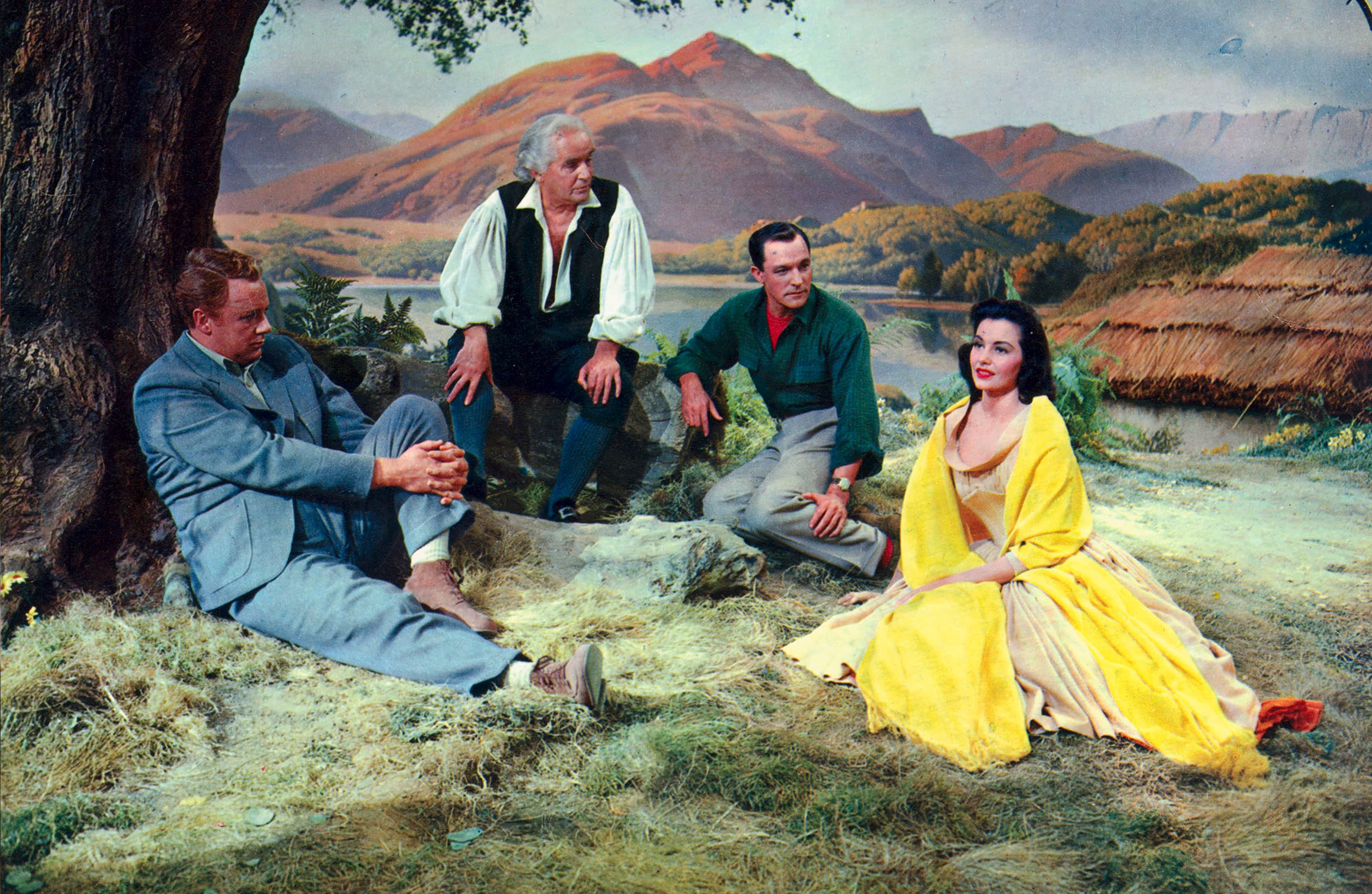
Van Johnson, Barry Jones, Gene Kelly, Cyd Charisse in Brigadoon
Cast: Gene Kelly, Cyd Charisse, Van Johnson, Elaine Stewart, Barry Jones, Hugh Laing, Albert Sharpe, Virginia Bosler, Jimmy Thompson, Tudor Owen, Owen McGiveney, Dee Turnell, Dodie Heath, Eddie Quillan. Screenplay: Alan Jay Lerner, based on his book for a stage musical. Cinematography: Joseph Ruttenberg. Art direction: E. Preston Ames, Cedric Gibbons. Film editing: Albert Akst. Music: Conrad Salinger; songs by Alan Jay Lerner and Frederick Loewe. 

Three years after Brigadoon, MGM's biggest musical star wasn't Gene Kelly or Judy Garland, it was Elvis Presley, who made Jailhouse Rock (Richard Thorpe, 1957) and eleven more movies for the studio. Arthur Freed, Brigadoon's producer, made six more musicals for the studio before leaving it in 1961, but Brigadoon is often regarded as a sign that MGM's golden age was ending. It's not an original movie musical like An American in Paris (Vincente Minnelli, 1951) or Singin' in the Rain (Kelly and Stanley Donen, 1952), the most highly regarded of the films produced by the Freed Unit, but an adaptation of a Broadway hit. It's also filmed in Ansco Color, widely regarded as inferior to classic Technicolor. It was originally intended to be shot on location in the Scottish Highlands, but the studio decided the weather was too uncertain there. After considering another location in California near Big Sur, the decision was made to film it entirely on a soundstage in Culver City. The expensive set earned an Oscar nomination for art direction, even though the decision to make the film in CinemaScope only magnified the artificiality of the artificial turf and painted sky. Brigadoon is not just stagey -- there are pauses at the end of musical numbers where the Broadway audience would have applauded -- it's soundstagey.  Kelly, who also choreographed, is in good voice and Cyd Charisse (whose singing voice was dubbed by Carol Richards) dancers beautifully, The song score by Alan Jay Lerner and Frederick Loewe is one of their best, including hummable tunes like "The Heather on the Hill" and "Almost Like Being in Love." (Although some of the songs from the stage version, including "Come to Me, Bend to Me" and "There But for You Go I," were cut.) Yet there's something lifeless about the movie. Van Johnson, who was cast in the role of Kelly's sidekick after Donald O'Connor was considered, seems a little bored with his part. The cutesiness of the village that outwitted time and space is a little too thick: There's something almost refreshing about the scenes satirizing life in New York near the end of the film, which are supposed to indicate that Kelly's character made a big mistake in not staying in Brigadoon. Vincente Minnelli directs these scenes with a sharpness and vigor that's absent from the rest of the movie. 

Sunday, December 31, 2023

Backfire (Vincent Sherman, 1950)

Edmond O'Brien, Gordon MacRae, and Virginia Mayo in Backfire

Cast: Gordon MacRae, Virginia Mayo, Edmond O'Brien, Viveca Lindfors, Dane Clark, Ed Begley, Sheila MacRae, Mack Williams, Leonard Strong, Frances Robinson, Richard Rober, David Hoffman, Ida Moore. Screenplay: Lawrence B. Marcus, Ivan Goff, Ben Roberts. Cinematography: Carl E. Guthrie. Art direction: Anton Grot. Film editing: Thomas Reilly. Music: Daniele Amfitheatrof. 

Backfire is a hyperplotted whodunit that aspires to some of the narrative complexity of Raymond Chandler but doesn't quite have what it takes. Gordon MacRae plays Bob Corey, recovering from war wounds in an Army hospital, who receives a visit one night from a mysterious woman (Viveca Lindfors) who tells him that his friend Steve Connolly (Edmond O'Brien) has been in a serious accident and is threatening to commit suicide; she asks for his help, but Corey has just been given a shot to help him sleep and passes out as the woman is talking. The next morning, he's not certain whether the woman was really there or if he dreamed about her visit. When he gets out of the hospital, the police contact him: Connolly is wanted for the murder of a notorious gambler and has disappeared. While in the hospital, Corey has fallen in love with a nurse, Julie Benson (Virginia Mayo), and with her help he begins the search for his friend. The rest of the story is told mostly in a series of flashbacks, some of them provided by people who get killed for telling Corey their stories, which all point to a high-roller with a mistress who is none other than the mysterious woman who visited Corey in the hospital. Some suspenseful moments and some entertaining performances keep the movie going, but the outcome is just a little too predictable. It's like one of those TV detective shows where the bad guy turns out to be that character actor you've seen before but can't quite place. This time, it's the actor whose name recognition is a little larger than their role in the movie seems to justify. 

Saturday, December 30, 2023

Ceddo (Ousmane Sembene, 1977)

Tabata Ndiaye in Ceddo
 Cast: Tabata Ndiaye, Alioune Fall, Moustapha Yade, Mamadou N’diaye Diagne, Ousmane Camara, Nar Sene, Makhouredia Gueye, Mamadou Dioum, Oumar Guèye, Pierre Orma, Eloi Coly, Marek Tollik, Ismaila Diagne. Screenplay: Ousmane Sembene. Cinematography: Georges Caristan, Bara Diokhane, Orlando Lopez, Seydina D. Saye. Art direction: Alpha W. Diallo. Film editing: Dominique Blain, Florence Eymon. Music: Manu Dibango. 

In Wolof, ceddo means something like "outsiders" or "others," but the subtitles for Ousmane Sembene's film translate it as "pagan." Which is appropriate in that Sembene's film is about that essential precursor to colonialism: the obliteration of an indigenous religion by a proselytizing religious authority. Ceddo is set in a village in Sub-Saharan Africa in precolonial times -- Sembene said that he imagined it to be the 17th or 18th century. The colony of French West Africa was established in 1895, but the colonizing vanguard was there much earlier in the form of Islamic and Christian missionaries. In Ceddo the village has been mostly converted to Islam, which the village king has accepted. But the ceddo resist the new religion, and kidnap the king's daughter, Dior Yacine (Tabata Ndiaye), who is supposed to marry a Muslim, in conflict with suitors upholding tribal tradition. The struggle to return the princess is bloody. Two white men, a slaver and a Catholic priest, observe the action like eager scavengers. Sembene tells the story with a mixture of straightforward narrative and touches that evoke the future under colonialism. The music track, for example, at one point contains a gospel song sung in English, suggesting the diaspora of slavery. And we see the Catholic priest with what appears to be his sole parishioner in his makeshift chapel, but Sembene cuts to a vision of what the priest longs for: a large congregation with nuns dressed in white and an image of black men rising into heaven. At one point, when the Islamic villagers have won a victory over the ceddo, the imam gives the forced converts their new names. The first one is called Ibrahim, but the second is tellingly given the name Ousmane. Ceddo is an ambitious film, made under difficult circumstances -- the dailies, for example, had to be sent to France to be processed, resulting in a lag of some weeks before Sembene and his crew could know if what they had shot was acceptable. But Sembene's achievement is a remarkable portrait of a continent in transition.   

Friday, December 29, 2023

A Mother Should Be Loved (Yasujiro Ozu, 1934)

Mitsuko Yoshikawa in A Mother Should Be Loved

Cast: Mitsuko Yoshikawa, Den Ohinata, Koji Mitsui, Seiichi Kato, Shusei Nomura, Shinyo Nara, Chishu Ryu, Yumeko Aizome, Shinobu Aoki, Choko Iida. Screenplay: Kogo Noda, Tadao Ikeda, Masao Arata, Yasujiro Ozu. Cinematography: Isamu Aoki. 

Ordinarily, I would regard watching a silent movie about mother love as a chore, not a pleasure. Especially if the movie is missing its first and last reels and doesn't have a music soundtrack to sweeten it. But A Mother Should Be Loved is an exception, mostly because it's directed by Yasujiro Ozu, who can be trusted not to slip into mawkishness and also to provide visuals that compensate for what's lacking in audibles. The story is emotionally complex: After the death of their father -- a role, played by Yukichi Iwata, that was lost with the movie's first reel -- Sadao (Seiichi Kato) and Kosaku (Shusei Nomura) are raised by Chieko (Mitsuko Yoshikawa). But when Sadao comes of age (now played by Den Ohinata) and applies to the university, he sees his birth certificate and realizes that Chieko is not really his mother -- he's the son of his father's first wife. He's upset at the deception but is quickly assured by Chieko that she loves him equally with Kosaku (now played by Koji Mitsui) and has tried to raise him as her own son. Eventually, however, Sadao suspects Chieko of overcompensating: treating him more generously than Kosaku. They argue, and when Kosaku learns that Sadao has upset their mother, he strikes him. Unwilling to fight back, Sadao leaves home and takes up residence in a brothel. When Chieko comes to plead with him to return home, Sadao refuses at first, but a maid in the brothel overhears their conversation and tells him her own story, which moves him so much that he relents. The reconciliation scene has been lost with the last reel, but is narratively inessential -- if the loss of any of Ozu's work can be deemed inessential. The delicacy of the performances and the lovely framing of each scene in the film overcome sentimentality. Ozu also slips in one of his allusions to other movies by decorating the brothel with a poster of Joan Crawford as Sadie Thompson in Rain (Lewis Milestone, 1932).